Seizures
Focal and generalised seizures are common, in infancy often as West syndrome with infantile spasms, and in many patients remain resistant to conventional anti-epileptic drugs.
Cureal treatment spectrum
For seizures associated with tuberous sclerosis complex (TSC), highly purified cannabidiol is approved as the finished medicine Epidyolex from the age of two as an add-on therapy when conventional anti-epileptic drugs do not work well enough. Other cannabis medications can only be considered off-label in individual cases for accompanying symptoms such as sleep disorders, inner restlessness or pain. At Cureal we always assess therapy in coordination with neurology, the specialist TSC clinic and existing medication.
Context
Tuberous sclerosis, also known as tuberous sclerosis complex (TSC), is a rare genetic multisystem disease. Mutations in one of the two genes TSC1 or TSC2 lead to overactivation of the mTOR signalling pathway, the central control point for cell growth. The result is benign growths, known as hamartomas, in several organs.
TSC occurs in about one in 6,000 to 10,000 live births. In Germany an estimated 8,000 to 12,000 people live with the diagnosis. The first diagnosis is often made in infancy or early childhood, and in milder forms only in adulthood.
The brain, kidneys, skin, heart, lungs and eyes are particularly often affected. Seizures occur in 80 to 90 per cent of patients, often early in life and frequently resistant to conventional anti-epileptic drugs. Treatment belongs in specialised neurological or paediatric care.
Symptom areas
TSC is not a single symptom diagnosis. Assessing the role of cannabis means looking at seizures, organ systems, accompanying medication and specialist care together.
Focal and generalised seizures are common, in infancy often as West syndrome with infantile spasms, and in many patients remain resistant to conventional anti-epileptic drugs.
Hypopigmented ash-leaf spots, facial adenoma sebaceum, rough shagreen patches and periungual fibromas can be visible signs of TSC.
Renal angiomyolipomas, cardiac rhabdomyomas and, in women, the lung disease LAM need regular monitoring.
Learning difficulties, attention problems, autistic symptoms, sleep disorders and inner restlessness are grouped together as TSC-associated neuropsychiatric disorders.
Anti-epileptic drugs, mTOR inhibitors such as everolimus, clobazam and other medicines determine interactions and treatment planning.
MRI, abdominal ultrasound, ophthalmology, cardiology and the specialist TSC clinic remain the central care structure.
Diagnostic work-up
TSC is not identified by a single test but on the basis of international consensus criteria and targeted examinations.
The diagnosis is made by the treating neurologist, paediatrician or specialist in human genetics, usually within a specialist TSC clinic or a university outpatient clinic. It is based on international TSC consensus criteria with major and minor clinical criteria, such as cortical tubers, hypopigmented patches or angiomyolipomas.
Genetic testing for TSC1 and TSC2 mutations additionally confirms the diagnosis but is not strictly necessary for a clinical diagnosis. In adults with a previously unknown diagnosis, treatment-resistant epilepsy and typical skin changes, a TSC work-up should be considered.
Conventional treatment
Treatment follows international TSC consensus recommendations and combines several building blocks. Medical cannabis complements this therapy but does not replace it.
For infantile spasms, vigabatrin is usually the first choice. Depending on the type of seizure, further anti-epileptic drugs such as valproate, lamotrigine, levetiracetam, topiramate or clobazam are added. In carefully selected patients, epilepsy surgery, a ketogenic diet or vagus nerve stimulation can also be additional options.
Since 2021, highly purified cannabidiol has been approved as the finished medicine Epidyolex from the age of two as an add-on therapy for seizures associated with tuberous sclerosis when conventional anti-epileptic drugs do not work well enough.
Cannabinoid system
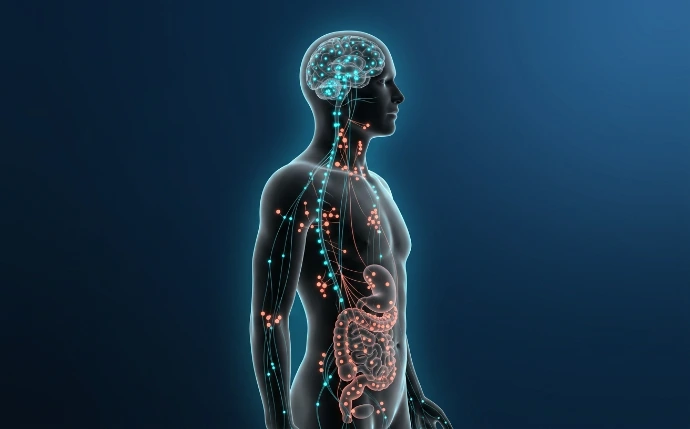
The body's own endocannabinoid system is involved in controlling neuronal excitability, the seizure threshold, stress processing and the regulation of sleep and wakefulness. Cannabidiol has a modulating effect on these systems through several mechanisms.
This breadth of function is the biological basis for cannabidiol being able to act both on seizures associated with tuberous sclerosis and on accompanying symptoms such as sleep disorders or inner restlessness. In the approved indication, Epidyolex has been available in Europe since 2021 as an add-on therapy from the age of two.
Beyond the approved use, medical cannabis can be considered as a complement in individual cases for persistent sleep disorders, inner restlessness or pain-related strain. CBD-dominant medications may be considered during the day, and low-dose THC-containing combinations can be used in the evening to stabilise sleep. This off-label use follows the principle of start low, go slow and is not supported by a dedicated TSC approval study.
Evidence
The research on cannabidiol for TSC-associated seizures is particularly robust compared with most other indications.
A randomised, double-blind, placebo-controlled phase 3 study (Thiele et al., 2021, JAMA Neurology) in patients with treatment-refractory TSC-associated epilepsy. Epidyolex showed a significant reduction in seizure frequency compared with placebo. This study is the basis of the 2021 EMA extension of the approval.
Since 2021, Epidyolex has been approved in Europe as an add-on therapy for TSC-associated seizures. An open-label extension study by French and colleagues (2021, Epilepsy and Behavior) confirms a sustained reduction in seizures over several years of treatment with an acceptable safety profile.
Legal situation
Medical cannabis has been available on prescription in Germany since 2017. In tuberous sclerosis, there is a clear distinction between approved and non-approved use.
Epidyolex is approved as an add-on therapy for seizures in TSC from the age of two. It is prescribed on a statutory health insurance prescription, and cost coverage by German statutory health insurance is the rule if the indication and prerequisites are met. Other cannabis medications are used exclusively off-label for accompanying symptoms such as sleep disorders, tension or pain; cost coverage here is assessed case by case and is not the rule.
Process
The treatment decision needs existing diagnostics, current seizure data, the medication plan and coordination with the treating specialist care.
The course of TSC, seizure frequency and anti-epileptic drugs and mTOR inhibitors already used are recorded in a structured way.
Previous medication and treatment response are reviewed before a cannabis option is assessed.
The doctor clarifies whether Epidyolex may be an option as an approved add-on therapy or whether off-label cannabis therapy for accompanying symptoms makes sense.
For the approved indication a statutory health insurance prescription is prepared; for off-label use the doctor issues a private prescription.
The dose is titrated up step by step. After two to four weeks, seizure frequency, sleep, tolerability and interactions are reviewed together.
Safety
In TSC patients, interactions with clobazam and everolimus are particularly relevant. Cannabidiol can affect the levels of both, which is why overall responsibility for the therapy stays with neurology, paediatrics or the specialist TSC clinic.

Frequently asked questions
These answers give you initial orientation. The specific assessment for your situation is made by the treating doctor.
For seizures associated with tuberous sclerosis complex, highly purified cannabidiol as the finished medicine Epidyolex, used as an add-on to standard anti-epileptic therapy, reduces seizure frequency. This is based on the randomised, double-blind, placebo-controlled phase 3 study by Thiele and colleagues (2021, JAMA Neurology), which led to the 2021 EMA extension of the approval. The effect sets in gradually during titration. Off-label cannabis for sleep, restlessness or pain is assessed separately.
For the approved indication of Epidyolex as an add-on therapy for TSC-associated seizures, it is prescribed on a statutory health insurance prescription, and cost coverage by German statutory health insurance is the rule if the indication and prerequisites are met. Off-label use of other cannabis medications is assessed case by case and is usually paid for privately.
Interactions with clobazam and everolimus are particularly relevant. Cannabidiol can raise the level of clobazam and of its active metabolite, which can lead to increased tiredness or sedation. The level of everolimus can also be affected. That is why close monitoring of drug levels and coordination with neurology or the specialist TSC clinic are needed.
Common side effects are tiredness, reduced appetite, diarrhoea and slight changes in liver values. In combination with clobazam, sedation can be more pronounced. Serious increases in liver values are rare and are detected early through regular laboratory checks. The adjustment therefore needs close supervision.
For TSC-associated seizures, Epidyolex is the approved cannabis option with its own body of research. Other cannabis medications are not approved for this indication and are not supported by direct TSC research. For accompanying symptoms such as sleep disorders or pain, they can only be considered off-label as a complement. Overall responsibility for the therapy stays with the specialist TSC clinic.
Related topics
TSC-associated seizures are linked to other conditions in the treatment spectrum.
Besides TSC, Epidyolex is also approved for Dravet syndrome and Lennox-Gastaut syndrome, and the principle of use is closely related.
Go to pageSativex is a further approved cannabinoid therapy for a neurological disease with spasticity.
Go to pagePain-related strain can accompany TSC and, as with other indications, is assessed off-label.
Go to pageIf TSC-associated seizures, sleep problems, restlessness or pain are a burden despite existing treatment, a medical consultation can clarify what role Epidyolex or off-label cannabis therapy can play in your case.