Tremor
Resting tremor, often first in one hand, is one of the classic early motor symptoms.
Cureal treatment spectrum
Parkinson's disease is treated neurologically with L-dopa and accompanying medication. Medical cannabis does not replace this basic therapy, but it can be assessed by a doctor in selected individual cases for non-motor accompanying symptoms such as sleep disorders, nerve pain, inner restlessness or anxiety.
Context
Parkinson's disease is a chronic, progressive neurological disease in which nerve cells that produce the messenger substance dopamine are lost. The resulting lack of dopamine leads to movement disorders and non-motor symptoms. According to data from the RKI Journal of Health Monitoring 1/2025, around 400,000 people in Germany live with Parkinson's disease, most of them over 60. The DGN S2k guideline on Parkinson's disease 2023 provides the methodological framework for treatment.
The exact causes have not been conclusively clarified. Genetic predisposition, oxidative stress, environmental factors and ageing processes play a role. Besides the core motor symptoms, non-motor symptoms often shape everyday life more than is commonly assumed: sleep disorders, pain, depressive symptoms, disorders of the autonomic nervous system and cognitive impairment. It is precisely in this area that medical cannabis can be assessed medically.
Symptoms
The disease presents on two levels, motor and non-motor. These points do not replace a diagnosis but help with an initial assessment.
Resting tremor, often first in one hand, is one of the classic early motor symptoms.
Muscle stiffness (rigidity) and slowed movement (bradykinesia) with a short-stepped gait considerably affect everyday life.
REM sleep behaviour disorder and problems falling or staying asleep are particularly common in Parkinson's.
Muscle and nerve pain can be a heavy burden alongside the movement disorder.
Depressive symptoms, lack of drive, anxiety and cognitive changes are common, even with well-adjusted medication.
Unsteady gait and an increased risk of falls must be taken into account with any therapy that is sedating or can cause dizziness.
Diagnostic work-up
A confirmed diagnosis and a well-adjusted treatment plan are prerequisites for considering cannabis therapy.
The diagnosis is usually made by neurology on the basis of clinical examination and medical history. If needed, imaging is added, for example a nuclear medicine procedure to assess the dopamine-producing cells or an MRI to rule out other causes.
Standardised questionnaires for assessing severity, known in technical terms as the MDS-UPDRS, record severity and course. The DGN S2k guideline on Parkinson's disease provides the methodological framework for all diagnostics and treatment.
Conventional treatment
Treatment follows the DGN guideline and has several layers: medication, complemented if needed by specialised procedures and lifestyle changes.
The choice of active substance depends on severity, age and individual tolerability:
In advanced disease or alongside medication:
Cannabinoid system
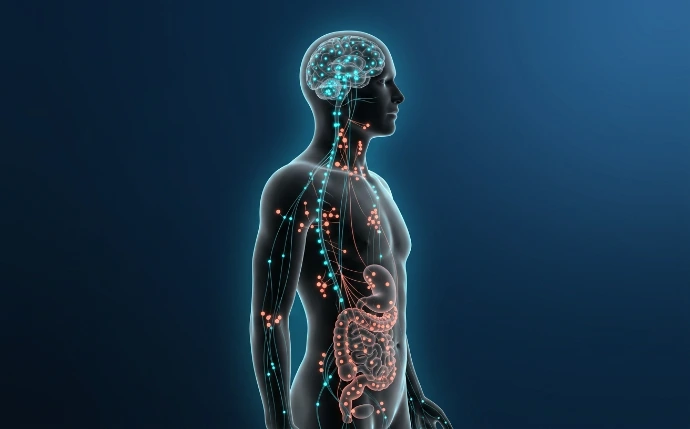
The body's own cannabinoid system (endocannabinoid system) is widely represented in the brain, including in the brain regions important for movement, pain, sleep and mood. Cannabis compounds such as THC and CBD bind to these receptors in the body and can have a regulating effect there.
For tremor, rigidity and bradykinesia, L-dopa remains the proven first line. Nevertheless, a review by a research team led by Urbi (2022) documents, in individual studies, indications of a reduction in L-dopa-induced dyskinesias and a reduction in tremor amplitude in stressful situations.
The actual area of use is non-motor accompanying symptoms: according to clinical experience and the research, sleep problems, nerve pain, inner restlessness and anxiety respond better to medical cannabis. In practice a CBD oil is usually used here. A research team led by Patel (2023) emphasises exactly this better evidence for non-motor symptoms compared with the core motor symptoms.
Evidence
The research clearly distinguishes between symptom areas: promising for non-motor accompanying symptoms, cautious for the core motor symptoms.
A systematic review in the Journal of Parkinson's Disease analysed eight high-quality comparative studies. One study showed a reduction in L-dopa-induced dyskinesias, another a reduction in tremor amplitude under stress. Other studies showed mixed results.
A comparative study published in Movement Disorders in 2024 examined a fixed CBD-THC combination in Parkinson's and found no significant advantage over a placebo. This underlines that the choice of active substance, dosage and individual adjustment are decisive.
Legal situation
Medical cannabis has been available on prescription in Germany since 2017, and the change in the law in 2024 made access easier still for patients.
In Parkinson's, use is outside the approved indication (off-label). Cost coverage by German statutory health insurance is possible if there is a serious illness and established therapies have not worked well enough, and is assessed case by case. In most cases therapy is on a private prescription.
Process
Cannabis on prescription for Parkinson's is decided individually and should fit in with existing neurological treatment.
The course of the disease, current Parkinson's medication and the most distressing accompanying symptoms are discussed. A brief check-in with the treating neurologist is part of the procedure.
L-dopa, dopamine agonists, MAO-B and COMT inhibitors and other medicines are checked for interactions.
If the indication is suitable, a private prescription is issued. The active substance, usually CBD-dominant, the strain and the dosage form, usually oil, are tailored individually. It is often a CBD oil, which is then adjusted slowly.
Treatment starts with very low doses following the principle "start low, go slow". After two to four weeks, tolerability and effect are reviewed together.
Sleep, pain, mood, balance, side effects and fitness to drive are monitored regularly over time.
Context
In Parkinson's, treatment is often started particularly cautiously. What matters is age, balance, sleep, current medication, cognitive situation and the type of accompanying symptoms.
Frequently asked questions
These answers give you initial orientation. The specific assessment for the individual situation is made by the treating doctor.
For non-motor accompanying symptoms such as sleep disorders, nerve pain or inner restlessness, many Parkinson's patients on medically adjusted cannabis therapy report a noticeable improvement in their quality of life. Studies such as the review by Patel (2023) and a case series in Frontiers in Human Neuroscience (2024) support these observations. Cannabis does not act directly on the core motor symptoms; here L-dopa remains the first-line therapy.
In practice, CBD-dominant medications come first because they are not psychoactive and are usually well tolerated by older patients. THC can be used as a complement at a very low dose when the pattern of symptoms suggests it, for example with very marked sleep disorders. The choice is made individually in the initial consultation and depends on the pattern of symptoms.
With CBD-dominant oils an initial effect usually appears after a few days to two weeks, and full adjustment generally takes four to six weeks. THC-containing medications work faster, but in Parkinson's the dose is increased very cautiously. At the follow-up appointment after two to four weeks the dose is adjusted together.
There is no general CBD dosage for Parkinson's. Adjustment is individual and follows the principle of start low, go slow: the treating doctor starts with a very low dose and carefully adjusts it to tolerability and effect at the follow-up appointment after two to four weeks. Self-dosing without medical supervision is not recommended in Parkinson's.
Possible side effects are tiredness, a dry mouth, mild dizziness or a temporary increase in heart rate, above all during the adjustment phase. In Parkinson's patients, sleep, mood and balance are also closely monitored. That is exactly what medical supervision is for: a low starting dose, regular monitoring and immediate adjustment if needed.
German statutory health insurance can cover the costs if there is a serious illness and established therapies have not worked well enough or were not tolerated. A carefully prepared application is a prerequisite. In the initial consultation we assess how realistic cost coverage is in the individual case and discuss the necessary documents.
Yes, a combination is quite possible if it is medically coordinated. L-dopa and the other Parkinson's medications are usually compatible with CBD-dominant medications. Interactions are manageable if the entire medication plan is discussed openly. That is exactly what happens in the initial consultation at Cureal.
Related topics
Parkinson's often occurs together with other conditions. These topics are closely linked.
Parkinson's pain can be assessed well with the findings from the wider field of cannabis pain therapy.
Go to pageSleep problems are among the most common accompanying symptoms in Parkinson's and those that respond best.
Go to pageDepressive symptoms are common in Parkinson's and can be addressed in their own right.
Go to pageIf sleep disorders, pain or inner restlessness are a heavy burden despite ongoing Parkinson's treatment, a medical consultation can clarify whether medical cannabis is justifiable for your situation.