Widespread pain
Pain in the muscles and connective tissue in several regions of the body at once, often changing and depending on how you feel that day.
Cureal treatment spectrum
Fibromyalgia is a chronic pain syndrome with widespread pain, exhaustion, sleep disorders and problems concentrating. Cureal medically assesses medical cannabis as a possible building block of a multimodal treatment approach.

Context
Fibromyalgia is a chronic pain syndrome with widespread pain in the muscles and connective tissue. Population surveys in Germany point to a prevalence of around two per cent, and women are affected considerably more often than men. Administrative health insurance data show lower figures, which is partly attributed to underdiagnosis.
The causes are not fully understood. Current models discuss an interplay of disturbed central pain processing, disturbed regulation of stress and sleep, and genetic predisposition. In 2016 a research team led by Russo suggested that the body's own cannabinoid system might be less active in fibromyalgia, which is also relevant to the possible use of cannabis compounds.
Besides the leading symptom of pain, deep exhaustion, unrefreshing sleep, fibro fog and sensitivity to stimuli shape everyday life. Irritable bowel syndrome, headaches and depressive symptoms often occur as comorbidities.
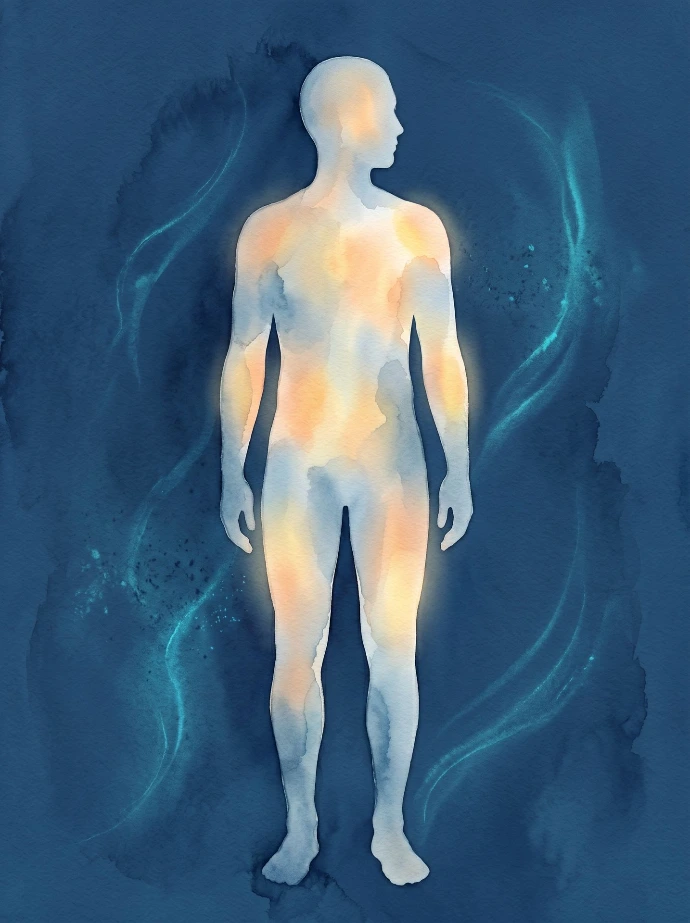
Symptoms
Symptoms often fluctuate widely. These points do not replace a diagnosis but help with an initial assessment.
Pain in the muscles and connective tissue in several regions of the body at once, often changing and depending on how you feel that day.
Marked tiredness and reduced resilience, even when you have objectively had enough sleep.
Problems falling asleep, waking frequently and the feeling of not having recovered in the morning.
Problems with concentration and memory that can make everyday life, work and social situations noticeably harder.
Sensitivity to touch, noise, changes in temperature or intense strain.
Irritable bowel syndrome, headaches and depressive symptoms often occur together with fibromyalgia.
Diagnostic work-up
Fibromyalgia is not identified by a single test but through the pattern of symptoms and exclusion diagnostics.
The diagnosis is usually made by rheumatology or pain medicine on the basis of the symptoms and tender points and after ruling out other diseases such as arthritis, thyroid disorders, diseases of the nervous system or deficiencies.
The international diagnostic criteria for fibromyalgia and the German medical guideline (AWMF register number 145-004) provide the methodological framework. A confirmed diagnosis is a prerequisite for every treatment decision, including the assessment of medical cannabis.
Conventional treatment
Treatment follows the German medical guideline and is multimodal: medical building blocks and lifestyle factors work together.
Aerobic endurance training has been shown to have a favourable effect on pain and exhaustion. In pain therapy, low-dose antidepressants such as amitriptyline or duloxetine are considered standard. Conventional painkillers such as ibuprofen or diclofenac and opioids are viewed with restraint in the guideline.
Besides medical therapy, everyday factors noticeably influence the course of the condition.
Cannabinoid system
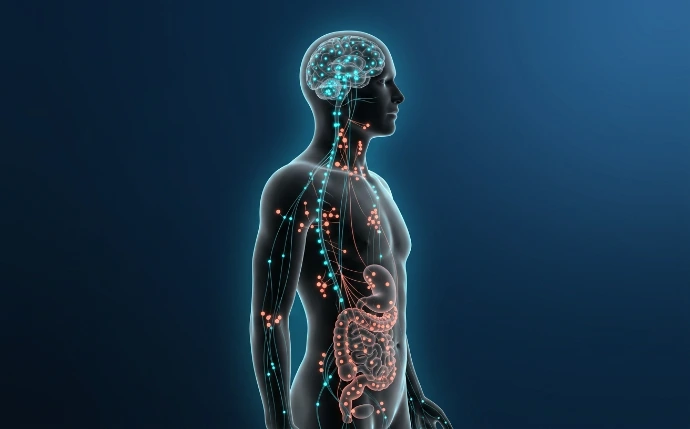
The endocannabinoid system is involved in pain processing, sleep, mood and inflammation. These are exactly the areas that play an important role in fibromyalgia. Cannabis compounds such as THC and CBD act on the same receptors in the body.
In 2016 a research team led by Russo summarised how the hypothesis of reduced activity of the body's own cannabinoid system can be applied to fibromyalgia, migraine and irritable bowel syndrome. This hypothesis has not been conclusively proven, but it currently provides the best theoretical model to explain the possible use of cannabis compounds.
THC binds to the same receptors and can influence pain modulation and sleep, which is why THC-dominant strains are often used in the evening. CBD is not psychoactive, and anti-inflammatory and antispasmodic effects are being discussed; in combination it can improve the tolerability of THC. Medical supervision with very careful dosing remains a prerequisite.
Evidence
The evidence is still being built up. Large multicentre comparative studies are so far lacking, while smaller studies and reviews provide initial indications.
Survey data point to a prevalence of around two per cent, and women are affected considerably more often. Administrative health insurance data show lower figures, which is partly attributed to underdiagnosis.
A study of the THC analogue nabilone, included in the 2025 living systematic review by the US health authority, showed in 40 patients an improvement on the standard fibromyalgia impact questionnaire compared with a placebo.
Legal situation
Access to medical cannabis is considerably easier today than it was only a few years ago. Medical cannabis has been available on prescription in Germany since 2017, and the change in the law in 2024 made access easier still for patients.
Fibromyalgia is one of the indications for which pain clinics already have experience with this use. Cost coverage by German statutory health insurance is assessed case by case; in practice, cannabis therapy for fibromyalgia is usually on a private prescription.
Process
Cannabis on prescription for fibromyalgia is not a given: the decision for or against cannabis therapy is always made by the treating doctor in the individual appointment.
The pattern of symptoms, a confirmed diagnosis, the exclusion of other causes and the current burden are reviewed.
Exercise, pain therapy, sleep measures, psychotherapy and previous medication are discussed.
The doctor assesses whether medical cannabis is justifiable as one building block of a multimodal plan.
If the therapy is suitable, a prescription can be issued and treatment started at a very low dose.
Effect, side effects, suitability for everyday life and fitness to drive are monitored over time.
Context
For fibromyalgia there is no one-size-fits-all strain and no one-size-fits-all prescription. What matters is the pattern of pain, sleep, sensitivity to medication, accompanying conditions and the existing building blocks of therapy.
Frequently asked questions
These answers give you initial orientation. The specific assessment for your situation is made by the treating doctor.
Some patients report a reduction in pain intensity, better sleep and more energy in everyday life. A nabilone study included in the 2025 living systematic review showed in 40 participants an improvement on the standard fibromyalgia impact questionnaire compared with a placebo. The individual response varies widely, and careful medical adjustment is a prerequisite.
Options include combination products with THC and CBD, THC-dominant strains and CBD-dominant strains. Combination products are often preferred because pain modulation and tolerability can be balanced well. THC-dominant strains may be considered in the evening when sleep-promoting effects are wanted. CBD-dominant strains are used during the day when a psychoactive effect is to be avoided. The specific choice belongs in the medical consultation.
CBD is not psychoactive and in fibromyalgia is considered in relation to inflammation, tension, tolerability and daytime functioning. Anti-inflammatory and antispasmodic effects are being discussed, and in combination with THC, CBD can improve its tolerability. CBD-dominant strains are therefore often used during the day when a psychoactive effect is to be avoided. Whether CBD alone or in combination with THC may be considered is clarified in the medical consultation.
Both may be considered, depending on the medical assessment. Inhaled cannabis via a vaporiser usually works within a few minutes and lasts two to four hours, while medications taken by mouth, such as oils or capsules, work more slowly, often only after 30 to 90 minutes, but last six to eight hours. In fibromyalgia, combination products with THC and CBD are often preferred because pain modulation and tolerability can be balanced well. Which dosage form and strain suit the individual case is determined in the medical consultation.
Possible side effects are dizziness, a dry mouth, tiredness, mild problems concentrating and a temporarily faster heartbeat. If the THC dose is too high, drowsiness or feelings of anxiety can occur. Patients with fibromyalgia often react particularly sensitively to medication, which is why treatment starts at very low doses. Particular caution is needed with cardiovascular disease, previous mental illness or pregnancy.
Compared with opioids or benzodiazepines, the risk of physical dependence is low. Psychological habituation is possible, above all with permanently high doses of THC. Under medical dose control within a therapeutic framework, this risk falls considerably. Ending therapy should be done gradually and always in consultation with the treating doctor.
In certain cases German statutory health insurers can cover the costs. The prerequisites are a serious illness and evidence that guideline-based therapies such as exercise, pain therapy or psychotherapy have not worked well enough or were not tolerated. In the initial consultation we assess whether an application has a good chance of success in your individual case.
A combination is often possible, because cannabis is meant to complement existing therapies rather than replace them completely. In some cases the need for conventional painkillers can be reduced. Interactions are possible in particular with antidepressants, sedatives and blood thinners. Before any change to therapy, all medicines currently being taken should be discussed openly.
The evidence is still being built up: large multicentre comparative studies are so far lacking, while smaller studies and reviews provide initial indications. A study of the THC analogue nabilone included in the 2025 living systematic review showed in 40 participants an improvement on the standard fibromyalgia impact questionnaire compared with a placebo. Further studies and reviews found indications of reduced pain intensity and improved sleep quality under cannabis therapy, while a recent review still classifies the evidence overall as limited. A final assessment is not yet possible on the basis of current research.
Related topics
Fibromyalgia often occurs together with other conditions. These topics are closely linked.
Cannabis may act here via similar mechanisms, and the condition often occurs as a comorbidity of fibromyalgia.
Go to pageUnrefreshing sleep is one of the core symptoms of fibromyalgia. Cannabis for sleep disorders has been well studied.
Go to pageDepressive symptoms are common in fibromyalgia. Here too, the body's own cannabinoid system may play a role.
Go to pageIf pain, exhaustion or sleep disorders are a heavy burden despite multimodal treatment, a medical consultation can clarify whether medical cannabis is an option for your situation.