Abdominal pain and cramps
Often in the lower right abdomen, frequently colicky and worse after meals. In acute flare phases the pain can dominate everyday life.
Cureal treatment spectrum
Crohn's disease belongs in gastroenterological care. Medical cannabis does not replace flare treatment, maintenance of remission, biologics or necessary surgery. It can be considered as a complementary symptom therapy if abdominal pain, nausea, loss of appetite or sleep problems remain a burden despite standard therapy.
Context
Crohn's disease is a chronic inflammatory bowel disease (IBD). Unlike ulcerative colitis, Crohn's can affect any section of the digestive tract from the mouth to the anus, most commonly the junction between the small and large intestine (terminal ileum). The inflammation extends through all layers of the bowel wall and can lead to scarring, fistulas and strictures.
In Germany around 320,000 people live with a chronic inflammatory bowel disease, about half of them with Crohn's disease. The disease often first appears between the ages of 15 and 35, and men and women are affected about equally often.
The disease typically runs in flares with phases of relative calm (remission) in between. Complications include strictures, fistulas between sections of the bowel or to the skin, and malnutrition with iron deficiency, vitamin B12 deficiency and loss of bone density.

Symptoms
Symptoms differ depending on the region affected and the phase of the disease. These points do not replace a diagnosis but help with an initial assessment.
Often in the lower right abdomen, frequently colicky and worse after meals. In acute flare phases the pain can dominate everyday life.
Several bowel movements a day, often with mucus or blood, sometimes with marked urgency and changed bowel habits.
Persistent nausea, sometimes vomiting, often accompanied by weight loss and malnutrition.
Chronic inflammation, sleep disorders and deficiencies lead to marked daytime tiredness, which can also persist independently of an acute flare.
Unintended weight loss, iron deficiency, vitamin B12 deficiency and loss of bone density must be taken seriously and treated as well.
Fever, signs of bowel obstruction, fistulas, heavy bleeding, dehydration or severe pain are not an indication for online cannabis treatment and call for urgent medical assessment.
Diagnostic work-up
The diagnosis is made by a gastroenterology practice or a hospital with a gastroenterology department, not by Cureal.
It is based on the 2024 S3 guideline on Crohn's disease from the DGVS, the medical history, physical examination, laboratory values (blood count, inflammatory markers such as CRP and faecal calprotectin) and endoscopic procedures such as ileocolonoscopy with biopsies, and if needed upper endoscopy and small bowel diagnostics via MR enterography.
Histologically, granulomas and transmural inflammation are looked for, which distinguish Crohn's from ulcerative colitis. For Crohn's disease, Cureal works exclusively on the basis of an existing gastroenterological diagnosis and in coordination with the treating practice.
Conventional treatment
Treatment follows the S3 guideline and has several layers. Medical cannabis complements these building blocks for persistent symptoms but does not replace them.
Acute flares are usually treated with glucocorticoids such as budesonide or prednisolone to contain the inflammation quickly. Because of their side effects they are not suitable for long-term therapy.
Short-term useAnyone who is to remain stable after a flare needs maintenance therapy. Conventional options:
Cannabinoid system
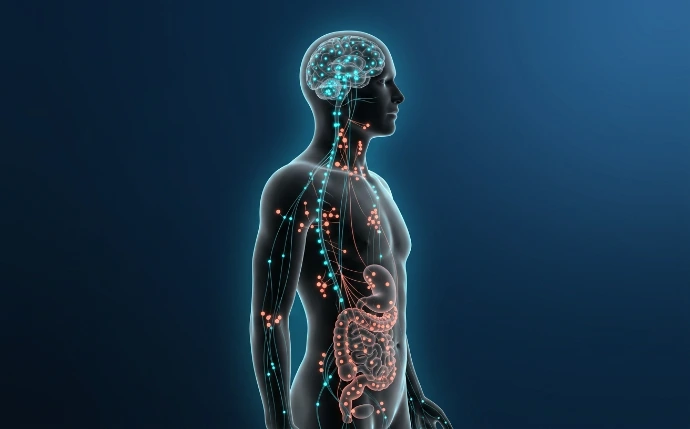
The body's own endocannabinoid system is particularly densely represented in the gastrointestinal tract. CB1 and CB2 receptors regulate bowel motility, pain perception, secretion and the inflammatory response, exactly the breadth of function regarded as the biological basis for using cannabis compounds for symptoms accompanying Crohn's.
THC-containing medications are associated with pain-relieving, appetite-stimulating and anti-nausea effects and are usually used at a low dose in the evening. In studies, CBD-rich medications show a clinical improvement in symptom burden without any improvement in endoscopic mucosal healing.
This does not replace reliable control of the bowel inflammation, fistula activity or strictures. Gastroenterological disease control remains decisive; at most, cannabis may be considered as a symptomatic complement.
Evidence
Compared with many other indications, the data is comparatively robust, above all for symptom relief.
Randomised controlled study (Clinical Gastroenterology and Hepatology): patients with treatment-resistant Crohn's disease received THC-containing cannabis cigarettes. The result was a clear reduction in the Crohn's Disease Activity Index compared with placebo, less abdominal pain, less nausea, better sleep and a better appetite.
A follow-up study by Naftali and colleagues (2017, Digestive Diseases and Sciences) found no relevant effect with low-dose CBD. A further study (2021, Journal of Crohn's and Colitis) showed a clinical improvement in the CDAI with CBD-rich oil, without mucosal healing. The Cochrane review by Kafil and colleagues (2018) and the work of Tartakover-Matalon and colleagues (2021, Pharmaceutics) discuss the mechanisms and call for further long-term studies.
Legal situation
Medical cannabis has been available on prescription since 2017. There is no approved finished cannabinoid medicine for Crohn's disease; it is used exclusively outside its approved indication (off-label), based on an individual medical decision.
Cost coverage by German statutory health insurance is assessed case by case. With documented treatment resistance, intolerance of standard therapy or severely restricted quality of life, the chances are higher than with a purely symptomatic indication. Most patients pay for cannabis therapy privately.
Process
The decision should fit in with gastroenterological treatment and is always made by the treating doctor in the individual appointment.
The course of your Crohn's, current flare activity, previous therapy (biologics, 5-ASA, glucocorticoids, immunosuppressants, any operations) and the dominant everyday symptoms are discussed.
The entire medication plan is checked for interactions, the symptom burden is assessed and everything is coordinated with gastroenterological treatment.
It is assessed whether cannabis therapy is medically justifiable for the individual situation.
If the indication is suitable, a private prescription is issued, usually a THC-containing medication for the evening and a CBD-dominant medication for the daytime, with a precise explanation of how to take them.
Treatment starts at a low dose following the principle "start low, go slow". After two to four weeks, effect, tolerability and how it fits with Crohn's treatment are reviewed.
Context
There is no standardised cannabis medication for Crohn's disease as a routine therapy. The active substance, dose and time of intake depend on the dominant symptoms, flare activity, complications and accompanying medication.
Frequently asked questions
These answers give you initial orientation. The specific assessment for your situation is made by the treating doctor.
In many patients, medical cannabis can ease abdominal pain, reduce nausea, stabilise appetite and support calmer sleep during flare phases. A randomised controlled study by Naftali and colleagues (2013) showed a clear improvement in the Crohn's Disease Activity Index with THC-containing cannabis compared with placebo. A follow-up study from 2021 with CBD-rich cannabis oil confirmed the clinical effect but stressed that direct endoscopic mucosal healing is not to be expected. Cannabis can ease symptoms but does not replace biologics and 5-ASA.
The choice is made individually in the initial consultation and depends on the dominant symptoms. For marked abdominal pain, nausea and loss of appetite, THC-containing medications come first, started at a low dose and increased slowly. CBD-dominant medications may be considered during the day to reduce stress and pain. Combination products with a balanced THC/CBD ratio are in many cases the practical solution.
No. According to current research, cannabis mainly eases symptoms (pain, nausea, appetite, sleep, quality of life). Direct endoscopic healing of the mucosa was not shown in the follow-up study by Naftali and colleagues (2021). Modifying the disease remains the job of established therapy with biologics, immunosuppressants and 5-ASA. Cannabis is a complementary symptom therapy, not a substitute for standard treatment.
A combination is possible in many cases but requires careful medical supervision. CBD and THC can affect how certain medicines are broken down by the liver, which can change their effects and side effects. Any adjustment of existing medication is made exclusively in coordination with the gastroenterology practice. In the initial consultation the entire medication plan is recorded and possible interactions are discussed openly.
Possible side effects are a dry mouth, tiredness the next day (above all if the evening dose of THC is too high), mild dizziness, a temporary increase in heart rate or a temporary increase in nausea during the adjustment phase. In patients with Crohn's, interactions with biologics and immunosuppressants must also be considered. That is why treatment starts low, is monitored regularly and is adjusted if needed.
Related topics
Crohn's disease often occurs together with other conditions. These topics are closely linked.
The second major chronic inflammatory bowel disease, with an overlapping range of symptoms and comparable areas of cannabis use.
Go to pagePersistent abdominal pain can become a burden in its own right even outside an acute flare. Cannabis therapy led by pain medicine can be considered here as a complement.
Go to pageSleep disorders caused by pain and stress are a typical accompanying symptom of Crohn's. Cannabis in the evening can stabilise sleep.
Go to pageIf abdominal pain, nausea, loss of appetite or sleep problems are a burden despite gastroenterological treatment, a medical consultation can clarify whether medical cannabis is an option for your situation.